


I’m biased in favor of Isaac Asimov’s Foundation.
It was the first “real” science fiction I ever read, way back in the mid ’80s, recommended to me by the father of my then-girlfriend (now wife), who was a lifelong sci-fi reader. After his passing twenty years ago, his Science Fiction Book Club edition of the original trilogy came to me—and I still treasure that old, beat-up, taped-together book.
As Foundation reaches its the 75th anniversary, I find it hard to assess the trilogy clearly. My opinion’s too slanted in its favor. Sure, I know they’re not perfect—far from it—but Asimov weaves such a pleasant spell that I regularly recommend this series.
Let’s explore why—including taking as sober a look at their weaknesses.
Note: I’ll keep this generally spoiler-free, but sometimes I have to dip into specifics to make a point. Be warned: here there be dragons. And a mule.
The Premise That Launched a Thousand Galaxies
First, the premise here is outstanding. From the Goodreads summary of Book I:
“For twelve thousand years the Galactic Empire has ruled supreme. Now it is dying. But only Hari Seldon, creator of the revolutionary science of psychohistory, can see into the future—to a dark age of ignorance, barbarism, and warfare that will last thirty thousand years. To preserve knowledge and save humankind, Seldon gathers the best minds in the Empire—both scientists and scholars—and brings them to a bleak planet at the edge of the galaxy to serve as a beacon of hope for future generations. He calls his sanctuary the Foundation.”
Wow.
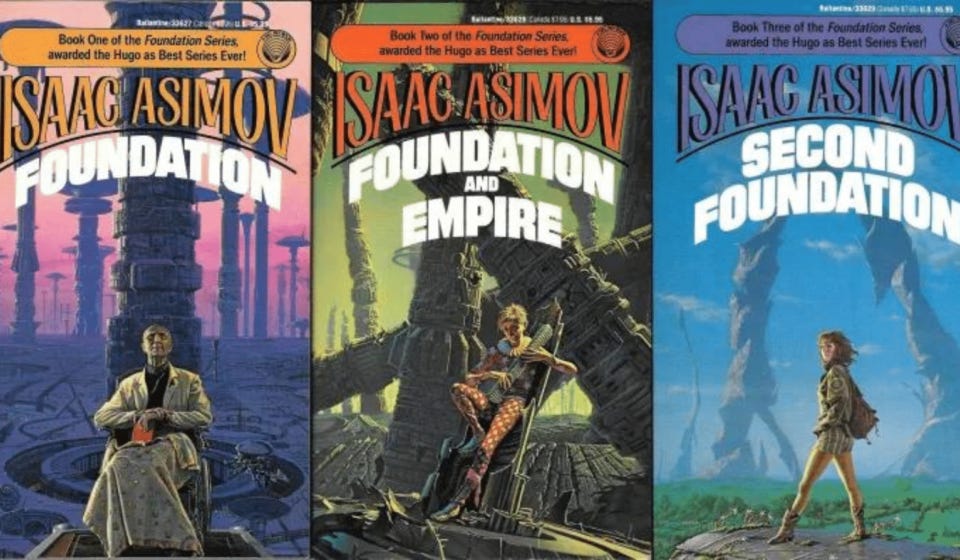
The story goes that a twenty-one-year-old Asimov pitched the concept to famed Astounding Magazine editor John W. Campbell in the early 1940s. He was reading Gibbon’s Decline and Fall of the Roman Empire; why not, he suggested, write about a galactic empire’s demise? And over a set of eight interconnected short stories Asimov did exactly that, later combining them into Foundation (1951), Foundation and Empire (1952), and Second Foundation (1953).
They were a smash, bestsellers praised by readers and the scientific community alike. They even won a special “Best All-Time Series” Hugo Award in 1966—beating both Edgar Rice Burroughs and The Lord of the Rings (and that was back when the Hugos meant something, too).
Moreover, the idea of a galaxy-spanning empire was so innovative and enticing that it became commonplace. Dune, Star Wars, and countless others owe Asimov a tremendous debt.
Chapters in History
Foundation isn’t a unified trilogy. There’s no one, single protagonist, no hero’s journey or character arcs to speak of. If you want that, go watch the (dreadful) Apple+ Foundation series. No, these books are a mosaic of episodes, each set in a different era with a new cast of characters. Each section dramatizes a specific crisis and the figures who rise to meet it. These are vignettes from a far-future chronicle, complete with entries from the “Encyclopedia Galactica” serving as historical epigraphs.
Some readers today call this a flaw, but I’d argue the exact opposite: it’s one of the series’ great strengths. This is not the tale of any one person or moment in time—it’s the sweeping story of an entire civilization.
More than its episodic structure, a 1940s Golden Age tone defines the work: clean, rational, pulpy in the best sense. Every story follows a neat “problem-struggle-solution” formula.
Oh no, the Foundation is threatened by its neighbor!
Oh no, a Foundation diplomat is about to be executed!
Oh no, a warlord is coming!
By the end of each chapter, rationalism and cleverness save the day. Like a mystery novel, not the strong but the smart are victorious. Asimov’s characters puzzle their way out of every mess, speechifying all over the place as they do–and it’s oh so satisfying. It’s what Fr. Justin (Edward) Hewlett calls “the embodiment of basic ‘geek’ principles: David triumphing over Goliath through superior intellect, brain over brawn.”
I find this pattern–however simplistic–immensely satisfying. There’s something delightfully nostalgic here, the mathematical tidiness of it. But Asimov never falls stagnant. Just when you’re lulled into his rhythm and begin to think the smarty-pants Foundation just can’t lose—boom—the Mule appears, upending Seldon’s Plan. Then comes the shadowy Second Foundation, turning the entire narrative on its head again. As we read on, we truly worry over the fate of the galaxy.
Character Talk and the Charm of the Cerebral
One fair criticism of Asimov is that his characters are flat as pancakes. This, again, is a relic of science fiction’s pulp days, which he himself admitted:
“While I have larger-than-life heroes, that is just because pulp fiction always did. (The Shadow, Doc Savage, etc.—I read them and was influenced by them.)”
In direct contrast with today’s emotional, character-driven fiction, each Asimov figure—Dornick, Hardin, Mallow, Seldon, the Mule—is more archetype than person. Think of it like a 1950s black and white movie: actors may have defining quirks or idiosyncrasies, but they fill a role in the story, that’s it. They serve as stand-ins for traits: logic, ambition, idealism, cunning. Or stereotypes: the warlord, the scientist, the aristocrat, the wife. While I can understand why readers in 2025 might struggle to invest due to this, it helps to see Asimov’s true interest lies in ideas and puzzles, not psychology. Intellectual excitement creates the drama here. Ideas in action, not well-rounded character studies.
The same applies to his “talking head” style. Characters sit around discussing. A lot. I’d estimate the series is 70 percent dialogue, 20 percent action, 10 percent description. Again, I enjoy this. It works. Asimov’s prose is so economical it wastes little time even describing settings before plowing forward–usually with another conversation. That no doubt drives some readers crazy today, but it fits Asimov’s “cerebral” tone. He once said he didn’t see stories in his imagination so much as hear them, and you can tell. Dialogue replaces spectacle, and because the stakes are always high, it remains compelling—think Twelve Angry Men in space, but with Asimov’s characteristic charm and wit. It’s a throwback in the best possible way.
Two Real Cracks in the Foundation
I do have two genuine complaints about the series, despite my affection.
First, if the Seldon Plan is meant to reduce the galaxy’s descent into barbarism to one thousand years, why does the original trilogy end after only about 200? While satisfying as a story thread and ending on a hopeful note, there are still 800 years to go. I remember upon first read being disappointed by that.
Of course, thirty years later Asimov returned in the 80s to extend the trilogy, and after his death in the 90s other authors picked up the ball and ran with it, too–but I’ll be honest, I’ve never reread those later books and probably won’t. Not only did I find them lackluster, they became more and more baroque, incorporating wild ideas like the Gaia “living planet” concept, as well as bringing Asimov’s other novels under the Foundation umbrella, creating an “Asimoverse”–including an outrageously powerful, history-manipulating robot. It just went off the rails for me.
My opinion; your own mileage may vary.
Second and more importantly, Asimov is a fundamentalist of scientism, and it shows. What I mean is that he essentially believes materialism to be the only pathway to truth–that to know something means to logically prove it. At its core, Foundation is written under the Golden Age of Sci-Fi’s hope for a “rational” future. I find it quaint the scientists (or, at least, logical thinkers) are the “good guys.” It’s fine for fiction, though I can imagine real life college professors, psychiatrists, and experimental labs taking over, governing according to “research says,” and manipulating society’s future. No thank you.
At the other end of his spectrum, religion is nonexistent in the galaxy both before and after the empire’s fall. Except, of course, for the hokum mumbo-jumbo used during the so-called “Dark Ages” to keep idiots in line. Not merely an opium of the masses, to Asimov spirituality is a cattle prod, a loaded gun–but without any real substance for anyone with common sense. Yes, the Foundation’s ploy to create a phony “Galactic Spirit” church to control its neighbors is entertaining–but it’s also unsettling. And disappointing. To humanists like Asimov, people are brains-on-sticks with a few renegade emotions to be manipulated by wise empiricists. The spiritual world doesn’t interfere in Foundation–in fact, it doesn’t exist.
And yet…
As with all classic materialists, Asimov has no problem with things so mysterious they border on mystical. To him, God and miracles are “obviously” ridiculous, but mutants and telepaths manipulating others’ thoughts through the power of their minds–even the emotions of an entire planet? Now that, that’s just science we can’t explain yet.
Even the basis of the novels–psychohistory–falls into this trap. As espoused by Hari Seldon, the behavior of societies for a thousand years in the future can be predicted with high degrees of certainty. Mathematically. And that which can be predicted can be controlled. I’ll grant this book was written in the 1940s when psychiatry and sociology were still gaining momentum, but the Seldon Plan is what I quite technically refer to as “bullshit science.” Only someone close-minded could scoff at religion, at Providence, at the supernatural, and yet worship at the altar of scientism like this. When I was a halfwitted teenage atheist in the 1980s, this was a feature of Foundation, not a bug; now as an Orthodox Christian in 2025, at the end of the Enlightenment in the West and the start of a new age of re-enchantment, I see this for the clear crack in the foundation it is. (Pun intended.)
Why I Still Love It
And yet, in the end I still adore this trilogy. The setup, the structure, the sheer ambition—few works have matched it since. Despite its cozy, dated style with cardboard characters and endless talking, it remains sharp, fast, and refreshingly hopeful.
Foundation embodies the optimism of mid-century science fiction: that knowledge can save us, that clever, intelligent people can and will steer civilization through its darkest hours, and that “violence is the last refuge of the incompetent.”
Foundation is a monument not to perfection, but a scientist’s creative dream that human reason and courage might still hold back the darkness—for a thousand years. I do miss that era of confidence, even as much as I disagree with it.
Thank you for stopping by the Reading Room! What do you think? Have you read Foundation? What did you think of it? Does it stand the test of time?
I agree that the last of strong characterization is one of the series’ strengths. The story of the Foundation Series is meant to be much larger than any one character. I also find the discussion on Asimov’s treatment of religion interesting. I’m not religious myself, but I’ve always had an appreciation for sci-fi that takes religion seriously (Dune, A Canticle for Leibowitz, Ender’s Game, etc.)
I reread it recently (for the first time in twenty years), and was surprised how well it held up. Yes, the characters are stereotypical old school sci-fi types, but that didn't bother me one bit.
I think Foundation still has relevance and a future...what actually prompted me to reread the series was that one of my kids took a philosophy class at their University and Foundation was one of the books to read.