


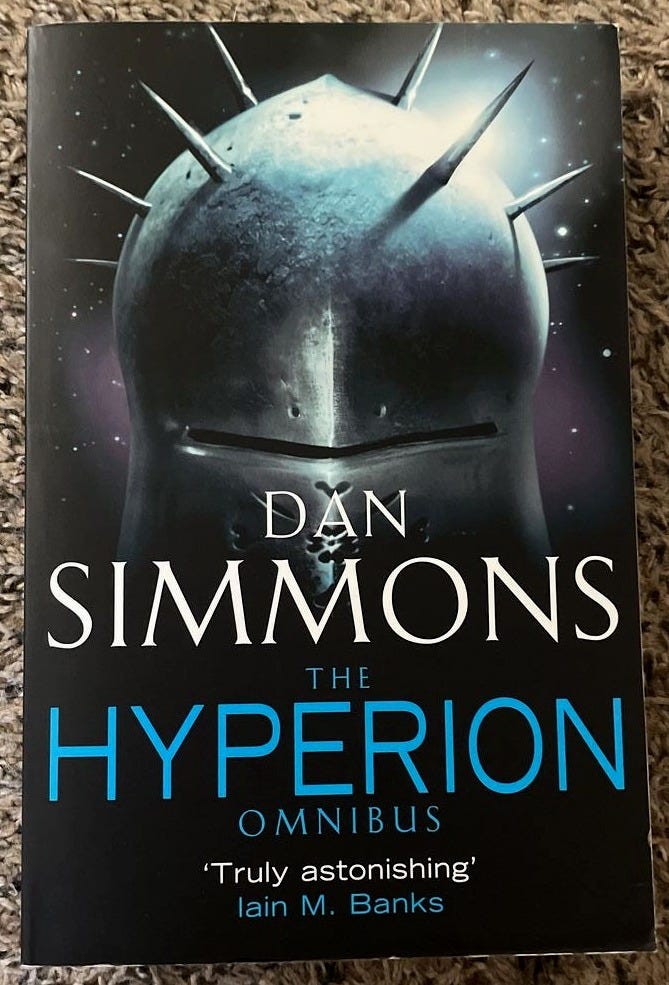
Look at any “best science fiction novels” list and there you’ll find Dan Simmons’ Hyperion. And deservedly so. It’s excellent.
However, while Hyperion is an achievement that will continue being hailed within the genre for decades to come, it ultimately stumbles just this side of “classic”—and that’s what pains me the most. It will eventually be forgotten, though this book had the potential to sit atop not only sci-fi readers’ favorites, but the ranking of greatest novels of all time.
But it’s not. Simmons just misses the mark.
Lets chat about it.
A Superb Premise
Let me give you as simple a rundown on Hyperion as I can–though please forgive me when I flub it. Summarizing this story is a monumental task. It’s downright baroque.
The tale, set 700 years in the future, at first seems fairly standard “galactic empire” fare: Humanity has conquered the stars, inhabiting and terraforming planets all across the galaxy. However, mankind has split into the “Hegemony” who occupy a great technological empire, versus the “Ousters,” a loose conglomeration of strangely-evolved, nomadic space-barbarians who threaten civilization from the fringes.
For most authors, that premise would be enough conflict to fill an 800 page novel—heck, for an entire series. But not for Dan Simmons. Galactic tension hardly scratches the surface.
For on the outskirts of known space lies the distant planet Hyperion, an isolated “outback” world. There, a bizarre anomaly has been discovered: the Time Tombs—a series of monuments, temples, and caves hurtling backwards through time. You read that right: the time tombs are from the future, but due to a mysterious chronological field, they’re not getting older, but younger.
But wait, there’s more.
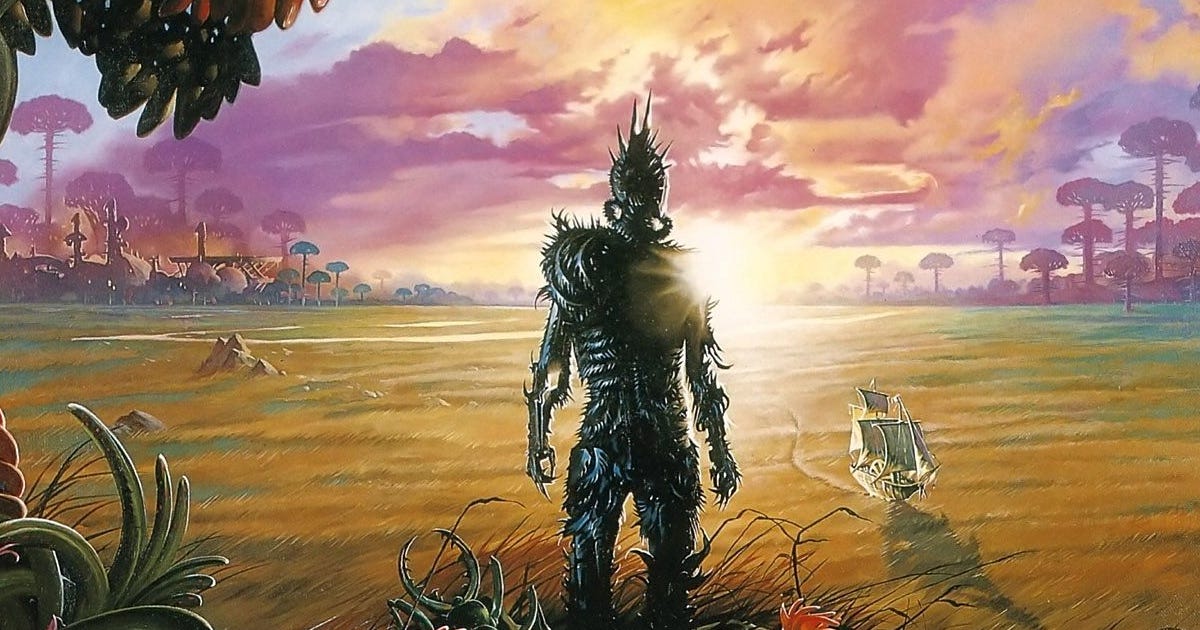
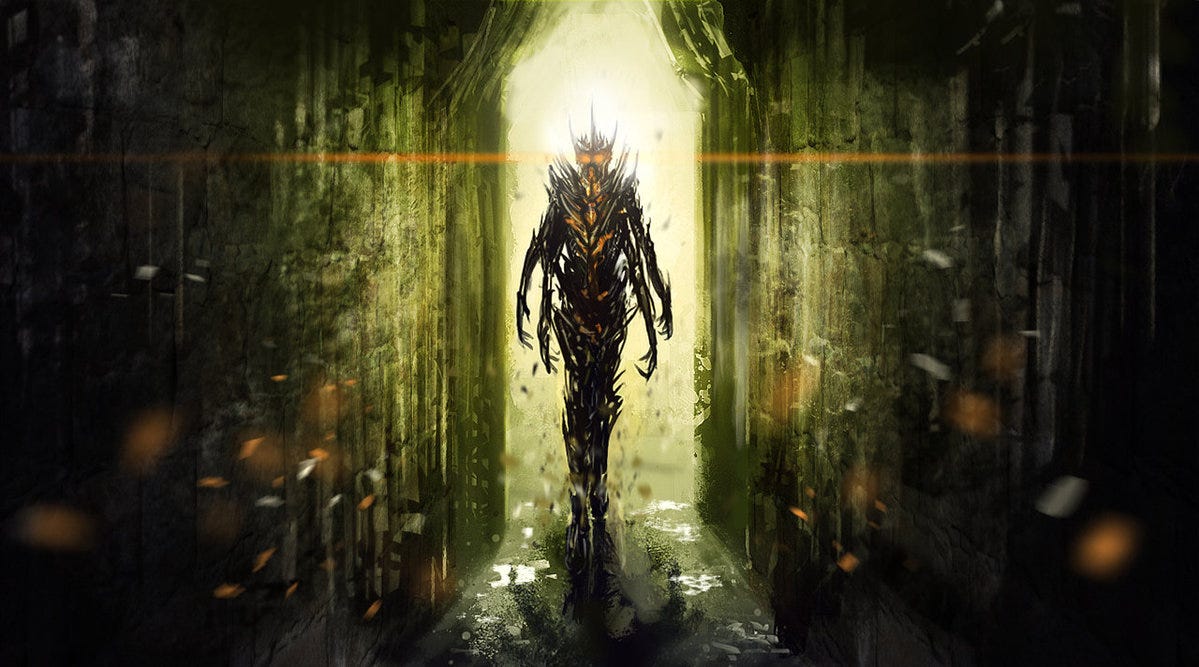
Somehow tied to this anomaly is a shadowy creature called the Shrike, a being that lends a strong horror element to the book. (Hyperion is bloody and terrifying—not for the squeamish.) Vaguely humanoid with four arms, covered in razor wire, blades, and spikes, no one knows who or what it is–only that it stalks Hyperion, murdering innocents, somehow using its powers over space and time to be everywhere and anywhere on the planet. The Shrike’s victims are dragged to a massive, thorny metal structure called the Tree of Pain where they are impaled to suffer for eternity. So terrifyingly mysterious is the Shrike that a galaxy-wide cult developed around it, convinced that soon (very soon) the Shrike—the so-called “Lord of Pain”—will be loosed on the entire galaxy to punish mankind for our sins. Fanatics even ritually travel to the Time Tombs hoping to be killed by the Shrike.
Which is exactly what our protagonists are doing.
The Church of the Shrike has for some unknown reason chosen six strangers to land on Hyperion exactly when the Ousters and Hegemony ready themselves to war over control of the planet. We thus start the novel by meeting our pilgrims, who collectively decide to voice their personal histories with Hyperion and the Shrike, plus why they’ve accepted this suicidal pilgrimage in the first place.
As each pilgrim’s tale unfolds–and the space battle rages overhead–we learn about this universe, its politics, its mind-bending technology, and of course the deadly Shrike.
And it’s fascinating.
Chaucer in Space
Although one long, unified story, Hyperion was originally published in two parts: Hyperion (1989) and The Fall of Hyperion (1990). The entirety of the first novel is consumed with the pilgrims’ tales, each divided by the frame narrative’s connective tissue describing their journey to the Time Tombs. The book is quite literally a set of interconnected short stories, and I can’t express how gripping, fresh, and engaging it is—not to mention exceedingly well written.
As a short story author, Simmons knocks it out of the park. Each tale is both exciting and satisfying, with two in particular standing among the best science fiction ever penned: “The Priest’s Tale” and “The Scholar’s Tale.” That latter proved one of the most moving reading experiences I’ve had in years. (I’m not ashamed to admit those particular pages in my book are now tear-stained. I can’t tell you how rare and wonderful that is for me.)
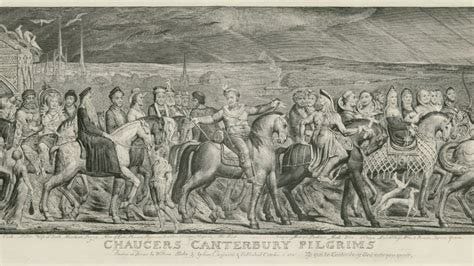
As I’m sure you’ve already noticed, the entire setup is a clear nod to Chaucer’s Canterbury Tales, in which medieval travelers pass the time story-swapping during a holy pilgrimage. Like Chaucer, Simmons divides his pilgrims by profession (the poet, the priest, the soldier, etc.), with each tale suited to its teller, both in content and style. For example, “The Detective’s Tale” parallels crime noir (with a cyberpunk flair), while “The Soldier’s Tale” is pure militaristic SF. I do wish Simmons had shifted every story into first-person point-of-view rather than sticking with third so that we delve into each characters’ voice, but this is a stylistic nitpick. These tales are outstanding.
Furthermore, as the stories progress, the universe of Hyperion is slowly but surely fleshed out for us readers, both inside and between them. And there’s oodles here to flesh out.
Because the novel begins in media res, we’re jammed into a foreign place, with casual mentions of bizarre things like farcasters, the World Web, the Technocore, the datasphere, Hawking drives, blue-skinned cybrids, and “treeships” (space vessels that are literally giant trees!) Even the familiar is twisted here, with Catholicism and Judaism being nearly extinct, yet each having their own little planet homes; a city named after the poet John Keats; and Earth long ago destroyed in the “Big Mistake” (whatever that is). It’s all so dizzying–even jarring at first. But as chapters pass, our hunger to understand is fed (somewhat), even as our wonder remains.
This first book is hands-down, jaw-droppingly excellent. Reading it, I grew more and more convinced Simmons rivaled Gene Wolfe as a grandmaster of science fiction. As I flipped to book two, I’d become a true Simmons fanboy. I couldn’t possibly have been more excited to read on, to learn how my lingering questions about the pilgrimage, the Shrike, and the Ouster/Hegemony conflict would be resolved. Surely an equally-stunning, satisfying conclusion awaited me.
Ah, but there’s the rub.
A Lackluster Conclusion
The story’s second half (The Fall of Hyperion), does not nearly rise to the towering heights of the first. It’s not “bad,” mind you, it’s just…well, disappointing. Lackluster.
While I would have been perfectly satisfied for Simmons to continue his “Canterbury Tales in space” framing device (I even thirsted for it), he completely abandons his pilgrim-centric, interconnected storytelling. Instead, we zoom out to something closer to epic sci fi. A bold move, to be sure. As was adopting an entirely different storytelling method, using a new character living halfway across the galaxy who “sees” across space and time in his dreams.
I suppose it wasn’t a poor idea to shake things up in the second 400 pages. I myself don’t understand why that decision was made, but I glean Simmons’ impulse. Nor is the new character’s “psychic dream” device a dumb idea–although it smacks of a cheap solution to narrative unity. Not to mention adding unnecessary layers of complexity.
Worst of all, as readers we’d come to love the pilgrims of Hyperion. We care for them, root for them, and feel dread over their inevitable arrival at the Time Tombs and the Shrike. But suddenly, they’re forced to share page space–even (in many ways) play second fiddle to an assortment of Hegemony politicians and generals arguing over the war effort, which now takes center stage. Not to mention major plot complications springing up, such as a conspiracy by Technocore AIs or the death of John Keats’ bioengineered body.
And there’s more, so much more than that, too.
Simmons dogpiles on characters, ideas, events, and landscapes. While a few of the twists and turns are fascinating, propelling the book onward, overall it’s too much. Too different. Too wide-ranging. And (I’m sorry to say) too flipping long. The second half could be cut by at least two hundred pages, it’s so bloated.
Ultimately, Simmons fails to stick the landing. What he resolves often feels rushed, dull, and occasionally even aggravating. Especially in his eye-rolling use of deus ex machina—first and foremost being how the Shrike is destroyed (if indeed it is??). This produced one of the stupidest “out-of-thin-air” contrivances I’ve read in a long, long time.
(For those who’ve read the book, I’m speaking of Brawne’s sudden “love magic” in Chronos Keep. Ugh. Second in stupidity would be the reveal of Moneta’s true identity. Double ugh. Third would be… Bah. Enough.)
Some enigmas remain confusing, too, unclear by the last page. This isn’t tough to understand, as Simmons had so many, many (many) plot and character threads to tie together. This book would be a masterpiece indeed if he had tied them all up.
But he didn’t. And it isn’t.
The Mystery Box
So what gives here? How did this incredibly skilled author fail?
As I reached page 750, I realized that Simmons is one of the most talented “mystery box” writers I’ve ever encountered—for both the good and the bad that implies.
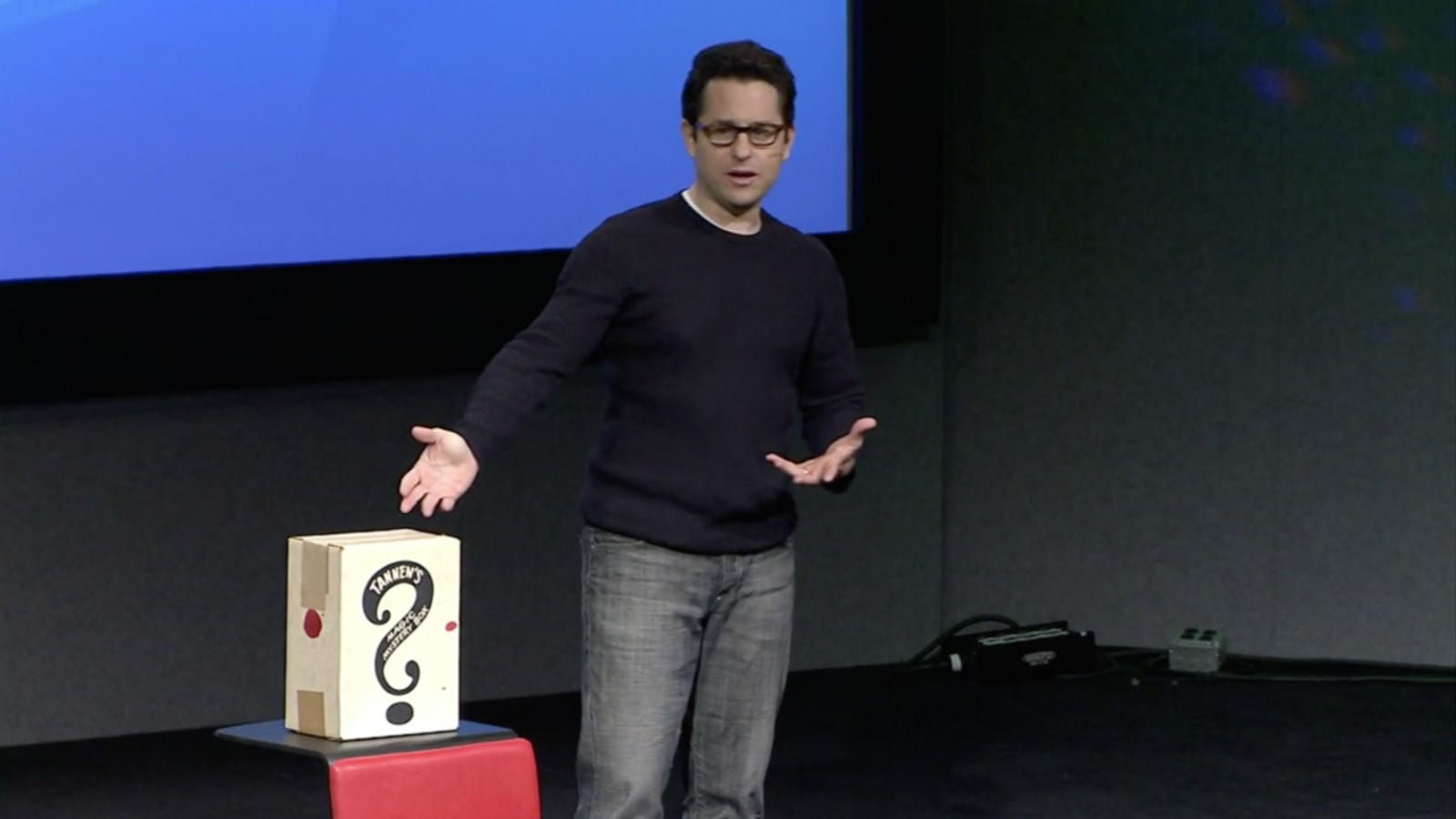
If you’ve not heard that term, “mystery boxes” were made famous in a 2007 Ted Talk by movie director J.J. Abrams, who showed the magic shop “mystery box” he’d bought as a child but never opened. Why? Because wondering what could be inside was more exciting, he said, than what he’d ever actually find if he actually opened it to look. Abrams turned that box into a metaphor for storytelling: the best part of stories, he claimed, are the thrills in not knowing—the suspense, the anticipation. This is what keeps viewers viewing and readers reading. It’s about hints, surprise, suggestions of the unexplained. Anyone who’s seen Abrams’ TV show Lost knows well the drug that is his “mystery dropping” (“Wtf? A polar bear on a tropical island?” “OMG, what’s in that hatch?” etc. etc. etc. on and on and on.)
The problem is that all stories must end—their mysteries must eventually get resolved. And creatives who focus on “mystery box dropping” often can’t give satisfying answers, as they’re more interested in whipping up suspense or confusion than answering their own questions. Take the ending of Lost as a famously-unsatisfying ending.
So too is Fall of Hyperion’s.
Simmons expertly builds suspense by baking us an intoxicating smorgasbord of futuristic sweet treats, each looking so delicious, tempting us, keeping us at the table with excitement and anticipation. But when at last we take a bite, we find the chocolate is just molded plastic, the cake made from sand. While Simmons dangles fascinating mystery after mystery before our noses, compelling us to turn pages, delighting us with “OMG what now?” moments, his mystery boxes are too many, his breadcrumb trails too convoluted. Most lead to either “meh” solutions or to nowhere. The story-world of Hyperion is outstanding, atmospheric, and downright crammed with intriguing characters and events, but Simmons struggles to do more than tantalize. This is doubly true the more vast and complex his ideas become: his ambitions proved too much for him, I think. Once Hyperion’s mystery boxes are unsealed, inside we find gold nuggets far less than mismatched pairs of tube socks.
So the second half—and especially the ending—disappoints. Not completely, but noticeably. And unfortunately, that tarnishes the first part. Maybe only degrading it from an A+ to an A-, but still.
The Fall of Hyperion, however…well, that’s C-level at best.
Why I Still Stand With Dan
If I come across as overly-critical, it’s because Hyperion could—maybe even should have been the perfect literary science fiction novel.
I was cheering for Dan the whole time. And although it didn’t quite pan out, I still stand firmly in his camp. That’s right: in the end, count me a badge-wearing Simmonsite (Simmonser? Simmonsie?)
Why? Because in our sad modern publishing environment, authors are pressured to write to formula. Cookie-cutter books in three acts with predetermined character arcs and perfectly-placed “save the cat” emotional beats, all tied up in the end with engineered ribbons and bows. This is why today’s traditionally-produced fiction (especially genre fiction) feels so, well, beige.
Simmons, though, stands above this. He chucked all “rules” and did his own thing, including:
Clever narration. His story doesn’t follow a simplistic, linear path, but instead uses clever narrative frames (sometimes even frames within frames), time jumps, and juggling a dozen perspectives.
A rich universe with lots to explore: rich history, far-future tech, alien landscapes, and truckloads to ooh and ahh over.
Top-notch prose. Simmons obviously loves language, as this is a well-crafted book. In spite of needing edits in the second half, both for length and for prose (ex: I swore if he described the sky as “lapis lazuli” one more time I’d scream), Simmons serves in many ways a writer’s writer.
Big ideas, and even bigger themes. Self-sacrifice. Self-reliance. The power and terror of religion. The very nature of the human race itself and our future. (Plus, his take on AI is far more fascinating today, 35 years after its publication, than in his own day) .
Pages dripping with allusions, ranging from classic literature (Dante, Keats, Chaucer, Beowulf, Romeo and Juliet) to modern pop culture (Raymond Chandler, the Wizard of Oz, “see you later alligator”) to Judeo-Christian imagery (Abraham’s sacrifice of Isaac, the “tree of pain” mimicking a crucifix, “love” being the glue that holds the universe together, the mystic Jesuit Teilhard…) Even if not all references gelled perfectly, part of the joy in reading Hyperion is spotting the literary Easter Eggs and noting how they deepen the novel.
While I likely won’t read the follow-up duology anytime soon (Endymion (1996) & The Rise of Endymion (1997)), I do encourage every serious reader and budding literary author to read and study Hyperion. Simmons attempted something new, something bold, something artistic. While he may fail to reach “classic” levels of greatness due to fumbling the ball on the ten yard line, these two novels are truly admirable. The creative risks taken are breathtaking.
So I’m with Dan, and if you too love good fiction, you should be as well. Simmons shot for the moon, and even if he missed–so what? That still put him among the stars.
Thanks for visiting the Reading Room today!
What do you think? Have you read Hyperion? If not, will you give it a shot? And I’m sure there are Hyperion fans out there who think I’m a rube for criticizing Fall of Hyperion—so let’s hear from you! What did I miss? How am I wrong?
As a self proclaimed “Simmonsite” you gotta read both Endymion to give a true assessment on this story arc. You might end up in the same place, some of Endymion is a slog, but the ending is worth it to the point where I caught myself tearing up, a very rare occasion.
I agree that the ending is Hyperion's major flaw. It's not fatal, in my opinion, because each story is so good on its own that the way the framing narrative pathetically fizzles out in a Wizard of Oz reference is forgivable. The story's bookends with the Priest's Tale and the Consul's Tale almost perfectly balance Hyperion. And the towering majesty of the Scholar's Tale (The River Lethe's Taste Is Bitter) is so beautiful and perfect that I've read that chapter multiple times on its own.
But if I can reference your recent work, Hyperion lacks something that makes literature like Tolkien's timeless. In Tolkien's case, I would say it's his concept of "eucatastrophe." Dozens of times in his work (Old Man Willow, Shelob's Lair, the Battle of the Pelennor Fields), an unexpected and miraculous event saves our beloved characters. But the way these events are resolved feels earned, almost in a spiritual sense and quite the opposite from a deus ex machina, due to the love, courage, wisdom, and heroism evident in the characters that bring them about. A transcendently talented writer would have brought everything to a climax at the end of Hyperion and tied everything up with eucatastrophe, even though I don't really see how it could work in Simmons' book.
As a complete tangent: I love the sci fi work of fellow Substacker Neal Stephenson, and if you haven't already you should read his magnum opus Anathem.