


Thanks for stopping by the Reading Room!
Things are really hopping around here, friends. Last week I had an outstanding experience: my literary fantasy novel, The Last Tale of Vastland, was requested by a respected literary agency. Wow!
I realize this is hardly a guarantee for traditional publication, but to have an industry professional tell me they love what I’m writing? It’s surreal. Almost like I’ve been transported to some wonderful new planet…
Speaking of which, let’s launch into today’s article!
Where Science Fiction and Literature Meet
Readers who appreciate not only an entertaining read, but a deep and meaningful reading experience have long enjoyed science fiction. It’s the literature of exploration–-not merely of other worlds or mind-blowing technology, but of ideas.
In my last article, I explored the tendency for SF to be aspirational, even when it paints a cautionary tale, so no need to dive into that again here. But I do think it worth reiterating what a modern phenomenon this genre is. There simply was no proper science fiction before the Industrial Revolution. Or, more specifically, since the Age of Reason conquered the West, shoving out earlier, less “scientific” ways of knowing–-be they superstition or theology. No, we humans were charting a new course for ourselves, led by logic, objectivity, and the drive to explore and innovate.
From this was SF born.
Readers in the 19th and 20th centuries were hungry for new tales of gadgets, space travel, and the future. It seemed only right. They were amazed at the rapid development of technology the Enlightenment had brought—and rightly so. I mean, I think of my grandfather, who lived through practically the entire 1900s: he saw the rapid evolution from horsepower, outhouses, and truly terrifying dentistry to a moon landing, the emergence of the computer, and miraculous medicine. It must have felt to Grandpa like we were seconds away from colonizing the stars.
And yet, looking back now, it’s clear not all change was good change–-and in some respects, the more we changed the more we remained the same. People are people after all, science hasn’t changed that. Yes, progress is a marvel, but left to its own devices science also dehumanizes. It can lead to mechanistic materialism, robbing life of meaning, of purpose. Besides, how can society as a whole cope with lightning-speed changes to literally everything we once knew?
Well, it turns out authors explored those exact questions all along, from the very beginning of the era. For every pulpy adventure rag about Flash Gordon or John Carter of Mars, there was a Frankenstein or a Fahrenheit 451, highlighting dangers both seen and unseen by the rest of us.
What’s more, novelists soon realized that SF is the perfect vehicle for allegory. Looking into the future or reimagining the past proved a great way to make a point about current ills such as greed or ambition, about cultural pitfalls or the dangers of nuclear or digital technology, plus a slew of other red flags. Yes, at times these authors were a bit obvious (even eyerolling—I’m looking at you Margaret Atwood.) But other attempts at “what iffing” proved sublime, written as well as any Great Book in the canon.
So let’s elevate those–-that second category of SF novels that are not only wildly inventive, not only have something important to say, but are out-and-out well-written literature.
Danger, Will Robinson
A few warnings about the list before we jump onto it.
First, as with my literary fantasy list and children’s lit list, I’m shooting for examples here, not the end all, be all, “one list to rule them all.” You’ll no doubt think me a rube for skipping some novels. (Feel free to call me out in the comments… I’ll probably agree with you.) In my defense, the goal here is to offer a sampler tray of genius works from the past 200 years of SF. I did a bit of research and even asked the fine folks of Substack to weigh in, but in the end these are just recommendations from little old me, a non-academic reader who’s enjoyed the genre for going on 40 years. Nothing more.
Also, I didn’t aim for any type of representative survey of speculative fiction’s many sub-genres–-though you’ll find plenty here (cyberpunk, military, time travel, etc.) While dystopian may be slightly outsized, I notice a lack of “hard” SF—meaning stories built from an engine of real-world science and tech (such as The Martian). This is probably because most hard SF writers tend to be engineers, astrophysicists, or chemists, not literary types. Space opera is also absent, unless you count Lewis or Herbert, though that’s a stretch; for all their fun, I can’t think of any such adventures I’d consider particularly well-written or thematically layered.
Finally, there are three or four books on this list I myself have not yet read. I’ve noted this in their descriptions, but included them anyway since these works just seem so obvious. All the rest I can personally recommend, though for many it’s been decades since my last reading. I was huge into SF in the late 80s/early 90s, but have not revisited all those books from my teens. (Yet.)
Okay, then. Without further ado, on with the list!
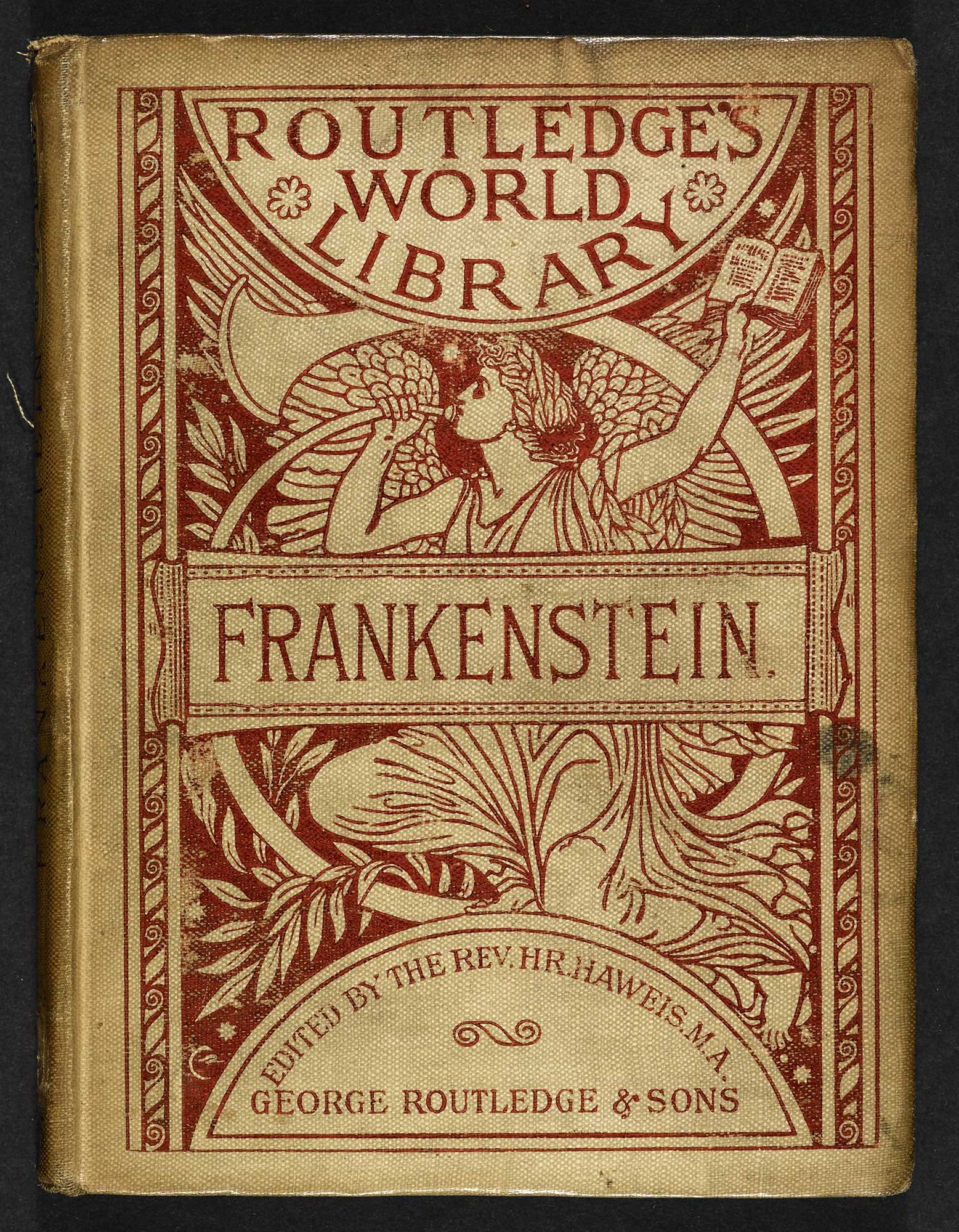
Frankenstein – Mary Shelley (1818)
Far more than the “monster movie” pop culture remembers, Frankenstein is one of the deepest novels ever written about scientific hubris and (though it sounds cliché) what it means to be human. The consensus is that Shelley practically invented modern science fiction (alongside Poe) and managed to pose questions we’re still wrestling with two centuries later.
Pitch: A brilliant young scientist creates life—but recoils in horror at his own creation, unleashing a tragedy that destroys everyone he loves.
Jules Verne & H.G. Wells (late 1800s)
I cheated here by lumping together two godfathers of SF (I’m a rebel like that.) The genre owes more to these two writers than perhaps anyone else. Verne specialized in thrilling adventures built on plausible science, while Wells used speculative ideas to explore society, morality, and humanity. Between them they invented many defining concepts, from submarines and moon voyages to time travel and alien invasions. Their writing may not be as literary as others on this list, but it’s still well-worth exploring.
Start with Twenty Thousand Leagues Under the Sea, Journey to the Center of the Earth, The Time Machine, or The War of the Worlds. They’re pretty short, and always imaginative.
The Strange Case of Dr. Jekyll and Mr. Hyde – Robert Louis Stevenson (1886)
A remarkably brisk novel that punches far above its weight. Stevenson transforms a gothic horror tale into a profound SF meditation on temptation, hypocrisy, and the “divided” nature of man—a classic dichotomy that we still grapple with today (our noble vs. savage natures.) Plus, Stevenson’s writing style is always a treat.
Pitch: A respected London doctor discovers a way to separate the good and evil within himself—with horrifying consequences.
A Connecticut Yankee in King Arthur’s Court – Mark Twain (1889)
It might seem odd I included this, but this is a time travel story that does what the best SF does: explores current society by comparing and contrasting it. In this case, “modern” America vs. medieval England. Though I can’t deny Twain falls for just every stereotype possible about “the dark ages,” his gusto for Yankee innovation and progress is a joy, and he (as always) has no problem critiquing all civilizations. (Plus, Twain is hilarious.)
Pitch: A nineteenth-century engineer wakes up in Camelot and attempts to modernize King Arthur’s kingdom—with disastrous results.
Brave New World – Aldous Huxley (1932)
This novel is fantastic. Often overshadowed by 1984, I actually think Huxley’s warning has proven even more prophetic. Rather than conquering man through fear, his dystopia enslaves humanity with pleasure, comfort, and endless distraction. It’s one of the most unsettling books you’ll ever read precisely because so much of it feels familiar.
Pitch: In a future where everyone is engineered to be happy, one man begins asking whether comfort is worth the price of freedom.
The Space Trilogy – C.S. Lewis (1938, 1943, 1945)
Lewis wrote these three novels partly in response to the bleak materialism he saw dominating science fiction, and as a result his imaginative trilogy combines planetary adventure with Christian theology and medieval cosmology. Few series inspire such wonder—and the last (That Hideous Strength) eerily predicted the takeover of academia by radical, deluded, self-serving Leftists.
Pitch: A quiet philologist is swept into an interplanetary struggle between cosmic good and evil that ultimately reaches back to Earth itself.
1984 – George Orwell (1949)
The definitive novel about totalitarianism. ‘Nuff said. What I and so many others find so terrifying is the idea so well fictionalized here that the greatest tyranny isn’t merely controlling what people do—it’s controlling what they think, remember, and even what words they can speak. Every generation should study this book (especially ours.)
Pitch: A lonely government worker secretly rebels against an all-powerful state that watches every move and rewrites reality itself.
Foundation – Isaac Asimov (1951)
Okay, please forgive me: this is my self-indulgent cheat on the list.
Although the first three Foundation novels were in fact groundbreaking and wildly popular, gifting us the idea of the galactic empire and consequently creating a truly enjoyable sci-fi classic, these are hardly “literary.” The writing is wooden, many ideas are hokey, but somehow it all works—and it was the first “real” science fiction novel I ever read. (Want to know more? Here’s my article on the good, bad, and ugly of the series.)
Pitch: As a galactic empire collapses, a mathematician devises a plan to preserve civilization through the coming dark age.
Fahrenheit 451 – Ray Bradbury (1953)
Though at times a little self-indulgent, Bradbury’s prose is hands-down marvelous—as is the concept. Beneath the famous book-burning premise lies a passionate defense of literature, independent thought, and the free life of the mind. It’s less about censorship than about a society that willingly abandons serious thinking (again, especially relevant to us today!)
Pitch: A fireman whose job is burning books slowly awakens to the terrifying emptiness of the world he’s helping to maintain.
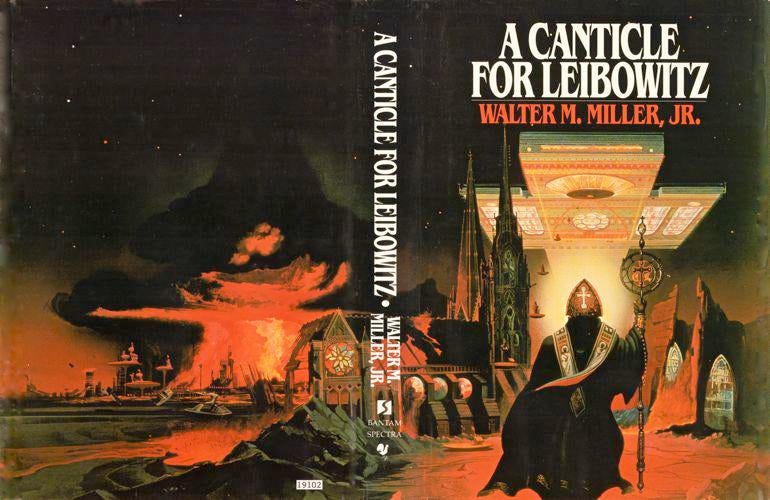
A Canticle for Leibowitz – Walter M. Miller Jr. (1959)
Oh, if you haven’t read this one yet, stop what you’re doing and pick it up. Now. My choice for the greatest post-apocalyptic novel ever written, this is equal parts heartbreaking, funny, and somehow hopeful. It follows generations of monks preserving knowledge after civilization collapses in fire and flame, and then rebuilds from the ashes. Miller, a Catholic, asks timeless questions about humanity, progress, and faith.
Pitch: In the centuries following nuclear war, a lonely monastery struggles to preserve the fragments of civilization for generations yet unborn.
Starship Troopers – Robert A. Heinlein (1959)
Militaristic SF fans rejoice. Though not as satirical as the film (which was also great, by the way), Heinlein’s novel is high octane military adventure—though beneath it all is an extended meditation on citizenship, civic duty, sacrifice, and political responsibility. Whether you end up agreeing with Heinlein or not, you’ll have plenty to think about.
Pitch: A young recruit matures into a soldier while fighting humanity’s war against a terrifying alien species.
Flowers for Algernon – Daniel Keyes (1966)
So I’ve never read this novel, but the award-winning 1959 short story it’s based upon is one of my all time favorites. Tear-jerker warning! This is one of the most emotionally devastating works in SF. Keyes explores intelligence, dignity, love, and loneliness through an unforgettable protagonist whose journal entries change as dramatically as his mind.
Pitch: After an experimental surgery makes him a genius, a mentally disabled man discovers that intelligence alone cannot guarantee happiness.
Do Androids Dream of Electric Sheep? – Philip K. Dick (1968)
I’ve tried reading Dick a few times over the decades and just can’t get into it—though I trust the many, many (MANY) readers who adore his works. He was truly original and wildly inventive. While Blade Runner became the famous adaptation of this particular work, it appears the novel is far stranger, far richer, and far more philosophical (which is saying a lot, as that movie is no slouch.) In essence, we’re asked what separates human beings from machines—and whether we’d like the answer.
Pitch: A bounty hunter tracks escaped androids through a ruined Earth while beginning to question what it truly means to be human.
The Left Hand of Darkness – Ursula K. Le Guin (1969)
I’m no Le Guin fan, but this (along with Lathe of Heaven) is a hands-down masterpiece of the genre. It combines extraordinary worldbuilding with deep anthropological and philosophical insight. It also explores gender, which is not a typical SF topic, as well as friendship, loyalty, and culture clashes.
Pitch: An envoy to a frozen world must earn the trust of a mysterious people if two civilizations are ever to unite.
Slaughterhouse-Five – Kurt Vonnegut (1969)
Obviously, a classic. Vonnegut is known for his darkly comedic style, and here that’s on full display. Unlike anything else you’ll ever read. The book blends time travel, satire, and the horrors of war in a way that somehow manages to be both absurd and moving at the same time.
Pitch: A survivor of the Dresden firebombing becomes “unstuck in time,” reliving every moment of his life in seemingly-random order.
A Clockwork Orange – Anthony Burgess (1962)
I tried this in the past, but couldn’t get past the invented language. (Note to self: give this one another shot soon.) Readers are fascinated by Burgess forcing us to confront uncomfortable questions about free will, morality, and whether a person can truly be good if goodness is imposed by force.
Pitch: A sadistic teenage criminal undergoes an experimental treatment that strips away his capacity for violence—but perhaps also his humanity.

Dune – Frank Herbert (1965)
One of the towering achievements of SF. Herbert combines ecology, politics, economics, and religious fanaticism into a sweeping epic that somehow never loses sight of its characters’ thru-lines. Plus, it’s one of the two best uses of omniscient narration (i.e., “head hopping”) that I’ve ever read (Lonesome Dove being the other.)
Pitch: A young nobleman is cast into exile on the galaxy’s most valuable planet, where destiny, religion, and revolution collide.
Neuromancer – William Gibson (1984)
I read this when it came out, and was blown away. This novel defined cyberpunk, propelling science fiction into the internet era. Gibson imagined cyberspace, hackers, artificial intelligence, and digital culture years before I had even seen the internet. Though it may be best known as a period piece, its also stylish and well written—though my horse sense tells me it is currently being forgotten.
Pitch: A washed-up hacker gets one final chance at redemption by pulling off an impossible digital heist.
The Book of the New Sun – Gene Wolfe (1987)
My favorite SF novel ever written. Wolfe demands patience and close reading, but oh how he rewards the effort. There are astonishing layers of theological symbolism here. Combined with its unreliable narration and literary craftsmanship, some call Wolfe the Melville of science fiction. This is SF at its most literary. Fantastic! (Want to know more? See my articles on this book here and here.)
Pitch: An apprentice torturer is exiled from his guild and begins a journey across a dying Earth where nothing is quite what it seems.
Hyperion – Dan Simmons (1989)
Imagine The Canterbury Tales in space—combined with a horror novel. Simmons combines truly unforgettable storytelling with amazing literary ambition, creating six remarkable, interwoven character narratives that gradually reveal one enormous mystery. It somehow manages to be thrilling, moving, and intellectually rich all at once. While Hyperion is actually the first book in a duology, I feel safe in saying most readers love this first book, while the second receives mixed reviews. (See my review here.)
Pitch: Seven pilgrims travel toward a legendary, deadly creature called the Shrike, each carrying a story that may determine humanity’s future.
The Plot Against America – Philip Roth (2004)
This one’s been on my TBR list for awhile now, as I’ve consistently heard how excellent it is. Technically alternate history rather than traditional science fiction, Roth chillingly imagines how fragile democracy can be when fear, populism, and prejudice take hold. I’m intrigued by how terrifying it is because (unlike, say 1984) everything sounds entirely plausible.
Pitch: An ordinary Jewish family watches America slowly transform after a populist hero wins the presidency and steers the nation toward authoritarianism.

The Road – Cormac McCarthy (2006)
McCarthy is my vote for the author of our time who will be remembered, and The Road is his foray into dystopian futurism. It’s bleak, yes—but also one of the most beautiful novels about love (namely, father to son) ever written. McCarthy strips civilization away entirely until we’re left—along with our protagonist—wondering what makes life worth living. Plus, McCartyh’s famous prose is, as always, practically biblical.
Pitch: A father and his young son journey through a dead, post-apocalyptic world, clinging to hope as they struggle simply to survive.
Thanks for stopping by the Reading Room!
So, as I said in the article, let me have it: what have I missed? What science fiction novels would you stick on here, boldly stating that they are both well-written and meaningful? Or, which one of these was I a bone head for including? Chime in and let’s chat about it.
I’d add The Sparrow by Mary Doria Russell - Jesuits make first contact. Culture series by Iain M Banks (maybe Player of Games as it’s fairly stand alone). Hello America by J G Ballard (any Ballard really)
Octavia Butler; if anyone can be called the successor to Le Guin, it’s Butler. A more current writer in the same vein is NK Jemisin.
Iain M Banks. Space opera with intelligence